.png)

ADHD paralysis is a state of being mentally overwhelmed that results in a physical inability to start a task, even when you know it is important. This frustrating "freeze" is not a sign of laziness or a character flaw, but rather a complex interplay between executive function deficits, emotional regulation challenges, and the unique neurobiology of the ADHD brain. This article will explore the psychological mechanisms behind this phenomenon and provide evidence-based Cognitive Behavioural Therapy (CBT) strategies to help you break the cycle, regain control, and move forward with your tasks.
Understanding the Mechanism of ADHD Paralysis
ADHD paralysis describes a state where an individual feels mentally overwhelmed to the point of being unable to initiate action. This "freeze" is a direct consequence of challenges with executive functions, the set of mental skills managed by the brain's prefrontal cortex. For individuals with ADHD, difficulties with task initiation are often linked to the brain's dopamine system, which plays a crucial role in motivation and reward. When a task is not inherently interesting, the ADHD brain may struggle to produce enough dopamine to activate the motivation required to begin, leading to a feeling of being stuck (Barkley, 2015). This experience is a legitimate neurobiological event, recognised within frameworks aligned with professional bodies like the Psychological Society of Ireland (PSI).
The Biological Reality of Executive Functioning
The prefrontal cortex is the brain's command centre, responsible for complex processes like planning, prioritising, and switching between tasks. In individuals with ADHD, this area of the brain functions differently, particularly in how it processes the importance of a task versus the interest it generates (Brown, 2013). This can lead to a situation where a person intellectually understands a task is urgent but cannot muster the mental resources to engage with it. According to the American Psychiatric Association (2022), executive dysfunction involves "deficits in the cognitive processes necessary for goal-directed behaviour". This means the very tools required to plan and start work are impaired, making the first step feel impossible.
Why Willpower is Not the Solution
A common misconception is that ADHD paralysis is a matter of choice or a lack of willpower. This belief is not only inaccurate but also damaging, often leading to feelings of guilt and shame. Traditional productivity advice, which often relies on sheer determination, frequently fails because it does not address the underlying neurobiology. The issue is not a lack of desire but an excess of "cognitive load". When the brain is overwhelmed by too many thoughts, decisions, or stimuli, it can trigger a complete system shutdown as a protective mechanism. Pushing harder in these moments only increases the cognitive load, worsening the paralysis.
The Role of Emotional Regulation in Task Freeze
The experience of ADHD paralysis is not just cognitive; it is deeply emotional. The feeling of being mentally stuck often translates into a physical sensation of being unable to move. This freeze is frequently triggered by an overwhelming emotional response, such as the fear of not performing a task perfectly or anxiety about the sheer volume of work ahead. This can activate the body's "fight, flight, or freeze" response, where freezing becomes the default reaction to a perceived threat (Ramsay, 2017). This state is often followed by a "shame spiral," where the inability to act leads to intense self-criticism, which in turn deepens the paralysis. Therefore, learning to manage your emotions is the critical first step toward managing your tasks.
Perfectionism and the Fear of Starting
For many with ADHD, an "all-or-nothing" mindset creates a significant barrier to starting tasks. The pressure to do something perfectly can make the initial step feel impossibly large. This is often connected to Rejection Sensitive Dysphoria (RSD), an intense emotional sensitivity to perceived criticism or failure. In a task context, the fear of not meeting one's own (or others') expectations can feel so threatening that avoiding the task entirely seems like the only safe option. For example, a simple task like replying to an important email can become a major source of anxiety if it is perceived as a test of one's competence and self-worth.
Breaking the Shame Cycle with CBT
Cognitive Behavioural Therapy (CBT) offers a structured approach to breaking this cycle. It provides tools to identify and challenge the distorted thoughts that fuel paralysis. A core technique is "thought catching," which involves noticing negative automatic thoughts (e.g., "I will fail at this," or "I am just lazy") and consciously reframing them into more realistic and compassionate ones. By intercepting these thoughts before they take hold, you can prevent the emotional spiral that leads to a complete freeze. For those looking to develop these skills further, the Collins Psychology emotional regulation course provides in-depth strategies.
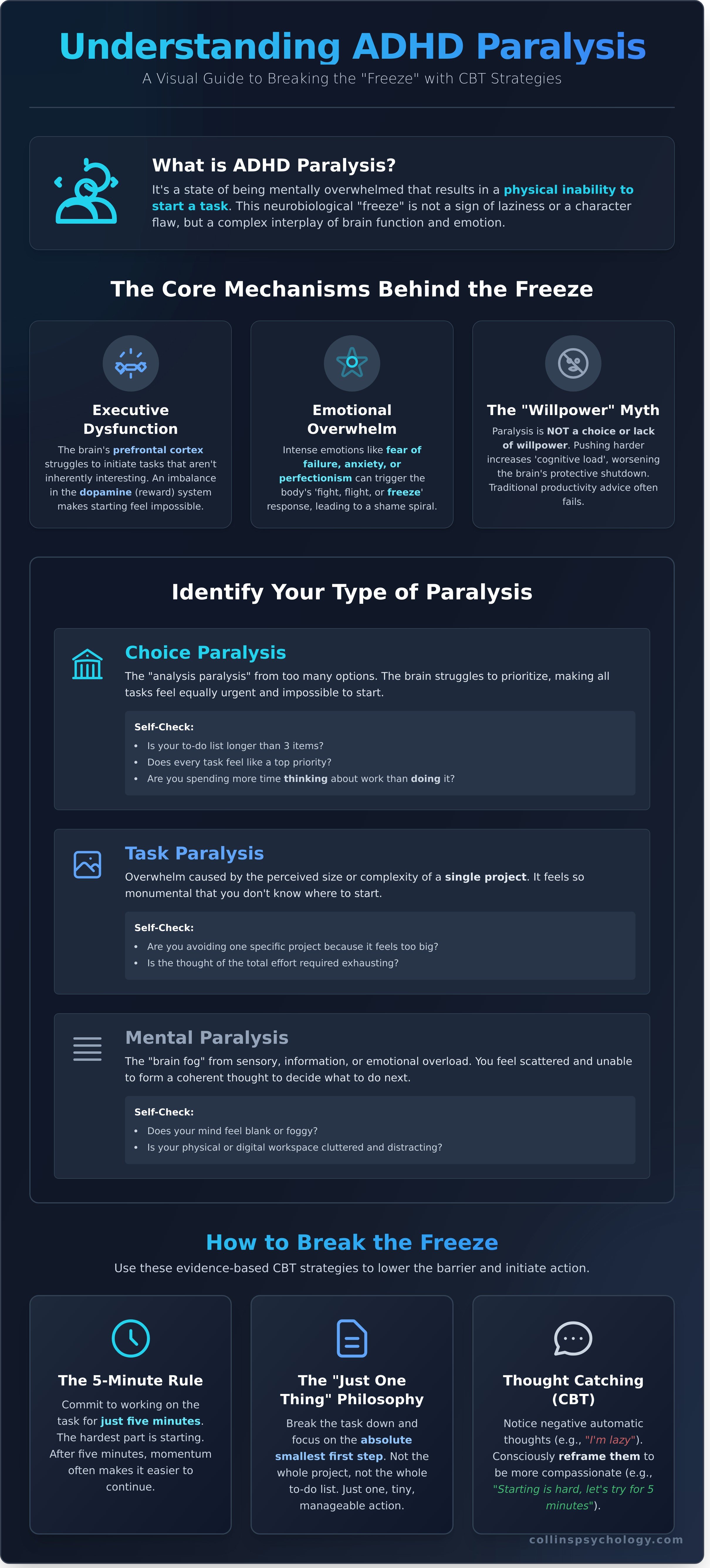
Identifying Your Specific Type of ADHD Paralysis
ADHD paralysis can manifest in several distinct ways. Understanding which type you are experiencing can help you apply the most effective CBT strategy to get moving again. Recognising the specific nature of your "freeze" allows for a more targeted intervention, moving you from a state of general overwhelm to one of clarity and action.
Choice Paralysis: The Burden of Options
Choice paralysis occurs when you are faced with multiple options or tasks and cannot decide where to begin. The ADHD brain can struggle to assign a hierarchy of importance, causing all tasks to feel equally urgent. This leads to a state of "analysis paralysis," where overthinking the options prevents any action from being taken (Safren et al., 2017). A common example is looking at a long to-do list and feeling so overwhelmed by the number of items that you end up doing none of them.
Self-Check for Choice Paralysis:
• Do you have a to-do list with more than three items on it?
• Do you feel that every task is equally important?
• Are you spending more time thinking about what to do than actually doing it?
Task and Mental Paralysis
Task paralysis is the overwhelm caused by the perceived size or complexity of a single project. The project feels so monumental that you do not know where to start, and the thought of the effort required is exhausting. Mental paralysis, on the other hand, is the "brain fog" that descends from sensory or information overload. This can be triggered by a noisy environment, too many open browser tabs, or simply mental exhaustion, leaving you feeling scattered and unable to form a coherent thought. Your environment plays a significant role in both of these states, either by adding to the cognitive load or by providing the structure needed to reduce it.
Self-Check for Task or Mental Paralysis:
• Are you avoiding one specific project because it feels too big? (Task Paralysis)
• Does your mind feel blank or foggy when you try to think about what to do next? (Mental Paralysis)
• Is your physical or digital workspace cluttered and distracting? (Environmental Factor)
Evidence-Based Strategies to Overcome the Freeze
When you are in a state of paralysis, the goal is not to complete the entire task but simply to break the inertia. CBT-based strategies focus on lowering the barrier to entry so that starting feels manageable. The key is to shift your focus from the overwhelming whole to a single, tiny first step.
Practical CBT Techniques for Task Initiation
The 5-Minute Rule
Commit to working on a task for just five minutes. Often, the hardest part is starting, and after five minutes, the momentum makes it easier to continue.
The "Just One Thing" Philosophy
Instead of looking at your entire to-do list, identify the single most important or easiest thing you can do right now. Break that one thing down into a "micro-task." For example, instead of "write report," the micro-task is "open the document and write one sentence."
The Pomodoro Technique
This method uses a timer to break down work into focused 25-minute intervals separated by short breaks. For the ADHD brain, this creates structure, urgency, and a clearly defined finish line, making a task feel less endless.
Body Doubling
This involves working alongside another person, either physically or virtually. The presence of another person provides external accountability and gentle social pressure that can help maintain focus and initiate tasks.
• For a more comprehensive approach, you can use CBT goal setting strategies to structure your day in a way that prevents overwhelm from building up.
Managing Cognitive Load and Environment
Your environment can either support or hinder your executive functions. Creating a "low-friction" workspace is crucial for preventing paralysis.
Externalise Your Brain
Do not rely on your memory. Use lists, calendars, and visual cues (like sticky notes) to keep track of tasks. This frees up mental energy for a single focus.
Reduce Sensory Input
During a mental freeze, try to minimise distractions. Put on noise-cancelling headphones, clear your desk of everything except what you need for the immediate task, and close unnecessary tabs on your computer.
Create a "Ready to Go" Workspace
Set up everything you need for a task the night before. If you want to go for a run in the morning, lay out your clothes. If you need to pay a bill, put the bill and your laptop on the table. This reduces the number of decisions needed to get started.
Building Long-Term Resilience Through Structured CBT
While immediate strategies are helpful for breaking out of a freeze, building long-term resilience requires developing your executive function and emotional regulation skills over time. Collins Psychology provides online, self-paced CBT programmes designed specifically for adults with ADHD. It is important to note that these are educational courses and not one-to-one therapy sessions. This model offers the flexibility to learn and apply evidence-based strategies without the pressure of appointments, allowing you to build the "muscles" of executive function at your own pace.
The Self-Paced Learning Advantage
The CBT for Adult ADHD programme is designed to fit the ADHD brain. You can engage with the material when you feel most receptive, without the anxiety of deadlines or scheduled sessions. The programme includes a variety of exercises, downloadable tools, and practical resources that help you translate knowledge into real-world skills. Designed by an experienced Irish psychologist, these programmes are structured to meet high professional standards, ensuring you receive credible and effective guidance.
Next Steps for Your ADHD Journey
The best way to start is by choosing one small area to focus on. Rather than trying to tackle everything at once, begin with a single module that resonates with your current challenges. A logical follow-up for those struggling with paralysis is the executive function course, which offers a deeper dive into the skills needed for task initiation and management.
To explore a structured, evidence-based path toward managing your ADHD, you can Access our structured, self-paced CBT programmes for Adult ADHD here.
Frequently Asked Questions
What is the difference between ADHD paralysis and laziness?
ADHD paralysis is a neurobiological response to being overwhelmed, stemming from executive function deficits. Laziness is a choice to not exert oneself. Someone in a state of paralysis often feels immense distress and a strong desire to act but is unable to, whereas laziness implies a lack of desire.
Can CBT really help with the physical feeling of being frozen?
Yes. The physical feeling of being frozen is often a response to overwhelming thoughts and emotions. CBT helps you identify and restructure these thoughts, which in turn calms the emotional and physiological response, allowing you to "unfreeze" and initiate action.
Is ADHD paralysis a symptom of inattentive or hyperactive ADHD?
ADHD paralysis can be experienced by individuals with all presentations of ADHD, including inattentive, hyperactive-impulsive, and combined types. It is fundamentally linked to executive dysfunction and emotional dysregulation, which are core features across the board.
How do I explain ADHD paralysis to my employer or partner?
Explain it as a "brain-based gridlock." You can say, "My brain gets so overwhelmed with signals about what to do that it temporarily shuts down the system that allows me to start. It's not that I don't want to do the task; it's that my brain's executive function for 'Go' is offline."
Does the Collins Psychology programme offer one-to-one therapy sessions?
No, Collins Psychology provides online, self-paced educational programmes. It does not offer one-to-one therapy. The courses are designed to give you the tools and strategies to manage your ADHD independently.
What is the best way to start a task when I feel completely overwhelmed?
The best way is to make the first step ridiculously small. Do not think about the whole task. Identify the absolute smallest possible action. If you need to do laundry, just pick one item of clothing off the floor. If you need to write an essay, just open the document.
How long does it take for CBT strategies to start working for ADHD?
Some strategies, like the 5-Minute Rule, can provide immediate relief in a moment of paralysis. Building long-term skills and changing thought patterns takes consistent practice over several weeks or months. The key is repetition and self-compassion.
Are these online programmes suitable for someone recently diagnosed?
Yes, absolutely. The programmes are designed to be foundational, providing a structured and comprehensive understanding of how ADHD affects you and what evidence-based strategies you can use to manage it. They are an excellent starting point for your journey.
References
American Psychiatric Association. (2022). Diagnostic and statistical manual of mental disorders (5th ed., text rev.).
Barkley, R. A. (2015). Attention-deficit hyperactivity disorder: A handbook for diagnosis and treatment (4th ed.). The Guilford Press.
Brown, T. E. (2013). A new understanding of ADHD in children and adults: Executive function impairments. Routledge.
Ramsay, J. R. (2017). Cognitive behavioral therapy for adult ADHD: An integrative psychosocial and medical approach (2nd ed.). Routledge.
Safren, S. A., Sprich, S. E., Perlman, C. A., & Otto, M. W. (2017). Mastering your adult ADHD: A cognitive-behavioral treatment program, therapist guide (2nd ed.). Oxford University Press.