.png)

For adults with ADHD, the line between being busy and being burnt out is often dangerously thin. The constant effort to manage executive function deficits, regulate emotions, and meet neurotypical expectations can lead to a state of profound exhaustion that traditional self-care advice fails to address. This guide explores the mechanics of the ADHD burnout cycle from a psychological perspective, offering proactive, evidence-based strategies rooted in Cognitive Behavioural Therapy (CBT). It provides a structured framework to help you move from a reactive state of recovery to a sustainable model of prevention, allowing you to build systems that work with your brain, not against it.
Key Takeaways
• ADHD burnout is a state of cognitive and physical depletion caused by chronic strain on executive functions, not a personal failing.
• Traditional advice like "take a holiday" is often ineffective because it does not address the underlying challenges with emotional regulation and executive functioning.
• Cognitive Behavioural Therapy (CBT) offers evidence-based strategies to reframe unhelpful thought patterns and build practical skills for managing energy.
• Prevention involves creating sustainable daily systems for sleep, movement, and task management that are adapted for the ADHD brain.
• Self-paced online learning programmes provide a flexible and accessible way to build a "toolbox" of CBT skills without the pressure of weekly therapy appointments.
Table of Contents
• Recognising the ADHD Burnout Cycle in Adults
• The Mechanics of Executive Function and Emotional Regulation
• Why Structured CBT is the Gold Standard for Prevention
• Practical Daily Strategies for Preventing a Crash
• Building a Sustainable Future with Self-Paced Learning
Recognising the ADHD Burnout Cycle in Adults
ADHD burnout is a distinct state of cognitive and physical depletion that results from the chronic strain of managing ADHD symptoms. It is the consequence of your brain's executive functions working overtime to keep up with daily demands. A significant contributor to this is "masking," the often unconscious process of concealing ADHD traits to appear more neurotypical in professional and social settings. This constant self-monitoring and suppression of natural tendencies consumes a vast amount of mental energy, accelerating the path to burnout. Research suggests that adults with ADHD are more susceptible to this state because the core challenges of the condition directly tax the brain's regulatory systems (Safren et al., 2005). It is crucial to distinguish this from clinical depression; while they can co-occur, ADHD burnout is primarily rooted in executive and cognitive exhaustion.
The Early Warning Signs You Might Be Ignoring
The initial signs of burnout are often subtle and easily dismissed as just a "bad week." A primary indicator is a sharp increase in irritability and a much lower tolerance for frustration; small setbacks that you would normally handle now feel monumental. You may also experience the "shutdown" response, where simple, low-effort tasks like replying to an email or making a phone call feel physically impossible to initiate. This is not laziness, but a sign that your cognitive resources are critically low. Pay attention to physical manifestations as well, such as persistent tension headaches, digestive issues, or a significant disruption in your sleep patterns.
Why Traditional Recovery Advice Often Fails
Well-meaning advice from neurotypical friends or colleagues often misses the mark for someone with ADHD. Being told to "just take a holiday" is unhelpful because burnout is not caused by a simple need for rest; it is caused by a fundamental mismatch between your brain's capacity and the environment's demands. A week off does not solve the underlying executive function deficits that will still be there when you return. Similarly, conventional self-care like bubble baths or mindfulness apps can feel inadequate when your nervous system is deeply dysregulated. These activities do not address the core issue, which is often the "boom and bust" cycle of hyperfocus, where intense periods of productivity are inevitably followed by a complete crash, perpetuating a long-term pattern of exhaustion. Understanding the ADHD burnout cycle is the first step toward breaking it.
The Mechanics of Executive Function and Emotional Regulation
Think of your daily energy as a finite resource. For an adult with ADHD, executive function deficits act like a constant fuel leak, draining this resource faster than it can be replenished. Executive functions are the brain's management system, responsible for planning, organising, initiating tasks, and regulating emotions. When these skills require more conscious effort, everyday activities become more taxing. Furthermore, emotional dysregulation, a core component of ADHD, rapidly depletes cognitive resources (Barkley, 2020). A minor frustration can trigger a strong emotional response, consuming the mental energy you needed for other tasks. This is compounded by decision fatigue, as the ADHD brain often struggles to prioritise, making each choice throughout the day feel more significant and draining. Your total "cognitive load" becomes unmanageable, leading directly to burnout.
Emotional Regulation as a Prevention Tool
Learning to manage your emotional responses is a powerful tool for burnout prevention. The key is to identify "micro-stressors" throughout the day before they accumulate and trigger a complete emotional hijack. For many with ADHD, rejection sensitive dysphoria (RSD) is a major factor in workplace burnout, where perceived criticism or rejection can cause an intensely painful emotional reaction. By developing skills to notice and soothe your nervous system early, you can prevent these emotional spikes from draining your executive function battery. Our structured system provides a foundational resource for developing robust CBT skills for emotional regulation.
Managing the Executive Function Battery
Visualising your executive function capacity as a mobile phone battery can be a helpful analogy. Every task, decision, and social interaction drains it, and some "apps" use far more power than others. A crucial step in preventing burnout is to identify your personal "high-cost" tasks, those activities that drain your reserves fastest, such as attending long meetings, navigating a crowded supermarket, or completing detailed administrative work. Once you know what drains your battery, you can manage it more intentionally by scheduling demanding tasks for when your energy is highest and building in "recharge" periods. To learn specific cognitive strategies for managing this daily energy budget, you can explore the Executive Functioning module.
Infographic: The ADHD Burnout Burnout Cycle
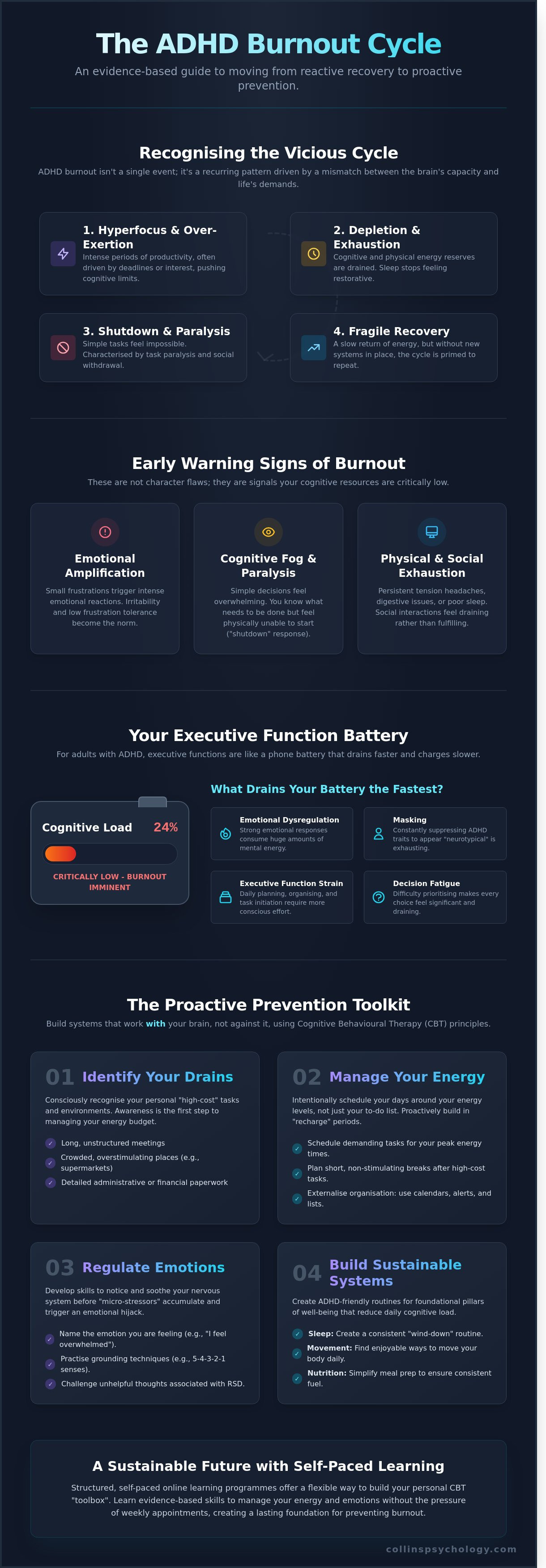
Signs You Are Approaching Burnout
Cognitive Fog
Simple decisions feel impossible.
Emotional Amplification
Small frustrations cause intense reactions.
Task Paralysis
You know what to do but cannot start.
Physical Exhaustion
Sleep does not feel refreshing.
Social Withdrawal
Interacting with others feels draining.
Your Proactive Prevention Toolkit
Identify Your Drains
Recognise which tasks and situations deplete your energy the most.
Schedule Recovery
Block out non-negotiable "recharge" time in your calendar, even if it is just 15 minutes.
Implement a "Minimum Viable Day"
On low-energy days, focus only on the absolute essentials to conserve resources.
Reframe Self-Talk
Use CBT techniques to challenge harsh self-criticism and replace it with compassionate, realistic thoughts.
Build Your System
Stop relying on motivation. Develop reliable routines for sleep, movement, and work that support your ADHD brain.
Why Structured CBT is the Gold Standard for Prevention
Cognitive Behavioural Therapy (CBT) is an evidence-based approach that is highly effective for helping adults manage the core symptoms of ADHD (Knouse et al., 2017). Its power lies in its structured, skills-based framework, which is particularly well-suited to the ADHD brain's need for clarity and process. CBT helps you identify and reframe the "all or nothing" thinking patterns that often lead to over-working and subsequent burnout. For instance, it teaches you to challenge the belief that you must complete a project perfectly in one go, instead encouraging a more sustainable, incremental approach. Importantly, these strategies are not about "fixing" you; they are about building a personalised toolkit of skills to navigate the world more effectively with your unique brain.
Reframing Thoughts to Reduce Stress
A core tenet of CBT is that our thoughts, not external events, determine our feelings. For adults with ADHD, a common cognitive distortion is comparing one's own pace to that of neurotypical peers, leading to thoughts like, "I should be able to do this as fast as everyone else." This constant internal monologue of self-criticism acts as an additional cognitive load, accelerating burnout. CBT provides a structured method for catching these automatic negative thoughts, examining the evidence for and against them, and developing a more realistic and compassionate internal dialogue that reduces stress and preserves mental energy.
Goal Setting Without the Guilt
Traditional goal-setting frameworks like SMART (Specific, Measurable, Achievable, Relevant, Time-bound) can often feel rigid and overwhelming for the ADHD brain, leading to procrastination and guilt. CBT helps you adapt these principles to be more dopamine-friendly. This involves breaking down large, intimidating projects into "micro-steps" that are small enough to feel achievable and provide a quick sense of accomplishment. This method helps you manage disorganisation and poor time management with CBT. Instead of starting over every Monday, you build momentum. For a structured approach to this process, you can find helpful resources in our Goal Setting system.
Practical Daily Strategies for Preventing a Crash
The key to long-term prevention is to build systems that work with your brain, especially on days when motivation is low. One powerful strategy is to define a "minimum viable day"—the absolute bare minimum you need to accomplish to keep life moving without feeling like a failure. This prevents the "all or nothing" trap where if you cannot do everything, you do nothing. Another critical component is establishing a consistent sleep hygiene routine that specifically accounts for the racing thoughts common in ADHD. Finally, incorporating regular physical movement, even in short bursts, is essential for regulating focus, boosting dopamine, and reducing the stress hormone cortisol.
Sleep and Fitness for the ADHD Brain
Sleep is your non-negotiable first line of defence against executive function collapse. Without adequate rest, your ability to regulate emotions, focus, and make decisions is severely compromised. To combat a racing mind at night, create a "shutdown ritual" an hour before bed—a consistent sequence of calming activities, such as reading a physical book, gentle stretching, or listening to quiet music, that signals to your brain it is time to wind down. When it comes to fitness, prioritise consistency over intensity. The goal is dopamine production and stress reduction, not athletic performance. Short walks, dancing, or any form of movement you genuinely enjoy are more sustainable than a gruelling gym routine you will abandon after a week. These are key pillars in creating the best lifestyle for an ADHD brain.
Parenting Challenges and Burnout
Parenting with ADHD adds a unique and intense layer of strain that can significantly increase the risk of burnout. Managing your own executive function challenges while simultaneously structuring life for your children is an enormous task. It is vital to schedule regular "sensory breaks" for yourself during high-stimulation family times, even if it is just five minutes alone in a quiet room to reset your nervous system. Learning to set and hold firm boundaries is also crucial. This is not about being a "bad parent"; it is about protecting your mental energy so you can be the consistent, regulated parent your family needs.
Building a Sustainable Future with Self-Paced Learning
For many busy adults, the idea of committing to weekly therapy appointments is a significant barrier to getting support. Online, self-paced CBT programmes offer a practical and effective alternative, allowing you to learn essential skills on your own schedule. At Collins Psychology, we provide these flexible tools rather than one-to-one sessions. This approach empowers you to build a toolbox of resources that you can access whenever you need them, especially before a crisis occurs. The ability to revisit modules and exercises during different life phases helps reinforce your learning and adapt your strategies as your needs change. This is not therapy. Not coaching. A system.
The Flexibility of Online Modules
Learning at your own pace removes the "performance anxiety" that can sometimes accompany traditional therapy. You can engage with the material when your brain is most receptive, without the pressure of an appointment. This flexibility makes it easier to integrate skill-building into a busy Irish work or family schedule. You can build your ADHD support system over time, focusing on the areas that are most challenging for you right now. Whether you are struggling with emotional regulation, time management, or focus, you can start where you struggle most. Our systems offer one clear path with multiple entry points, which you can see in the full collection of programmes available.
Taking the First Step Toward Prevention
The most crucial step in managing ADHD burnout is to act before the cycle is complete. Shifting your mindset from reactive recovery to proactive prevention is an investment in your long-term health, productivity, and well-being. By engaging with a structured, self-paced learning system, you are not just getting information; you are building the capacity to know what to do AND actually do it. Stop waiting for a crash to take your well-being seriously. You can start building a more sustainable and manageable life today.
Explore our CBT for Adult ADHD programmes today.
Frequently Asked Questions
What is the main difference between ADHD burnout and depression?
While they share symptoms like fatigue and low mood, ADHD burnout is primarily caused by cognitive and executive function exhaustion from managing ADHD. Depression is a broader mood disorder. Burnout may lift with extended rest and environmental changes, whereas depression often requires more specific clinical intervention.
Can I recover from ADHD burnout without taking time off work?
It is possible but challenging. Recovery often requires significantly reducing your cognitive load. This can be achieved by modifying your workload, delegating tasks, adjusting your schedule, and implementing the CBT strategies outlined in this article to manage your energy more effectively.
How long does it typically take to see results from CBT strategies?
With consistent practice, you can start to notice small changes in your thinking and daily functioning within a few weeks. Significant, lasting change is a gradual process that involves building new habits and skills over several months.
Is a self-paced programme as effective as one-to-one therapy for ADHD?
For many individuals, a structured, self-paced programme can be highly effective, particularly for building foundational skills in executive functioning and emotional regulation. It provides the tools and systems for change. The effectiveness depends on the user's commitment to applying the strategies consistently. It is a different model of support, not a replacement for clinical therapy for complex issues.
Do I need a formal diagnosis to start these CBT modules?
No, a formal diagnosis is not required. Our programmes are designed for any adult who identifies with the challenges of emotional dysregulation, inattention, or executive dysfunction, regardless of their diagnostic status.
How can I explain ADHD burnout to my employer or family?
Explain it as a state of cognitive exhaustion, not a lack of motivation. You can use the analogy of a computer with too many programmes running in the background, causing it to slow down and freeze. Emphasise that you need to reduce your cognitive load and implement specific strategies to manage your energy sustainably.
What should I do if I feel a total shutdown is imminent?
Immediately reduce demands. Activate your "minimum viable day" protocol. Focus only on essential tasks: eating, sleeping, and basic hygiene. Postpone everything that can wait. Engage in low-demand, restorative activities and reach out to a trusted person for support.
Are these programmes suitable for both inattentive and hyperactive types?
Yes. The core challenges of executive dysfunction and emotional dysregulation are present across all presentations of ADHD. The CBT strategies and systems are designed to address these fundamental mechanisms, making them applicable and beneficial for adults with inattentive, hyperactive-impulsive, or combined presentations.
References
Barkley, R. A. (2020). Executive functions: What they are, how they work, and why they evolved. Guilford Press.
Knouse, L. E., Zvorsky, I., & Safren, S. A. (2017). An update on the evidence-based psychosocial treatment for adult ADHD. Focus, 15(2), 153-167.
Safren, S. A., Otto, M. W., Sprich, S., Winett, C. L., Wilens, T. E., & Biederman, J. (2005). Cognitive-behavioral therapy for ADHD in medication-treated adults with continued symptoms. Behaviour Research and Therapy, 43(7), 831–842.