.png)

Discover evidence-based CBT exercises designed to help adults with ADHD overcome chronic low self-esteem and build lasting confidence through practical, self-paced strategies. For many adults with Attention-Deficit/Hyperactivity Disorder (ADHD), the internal landscape is often defined by a harsh inner critic and a persistent feeling of not quite measuring up. This article provides a structured, Cognitive Behavioural Therapy (CBT) approach to dismantling these negative self-perceptions and building a foundation of genuine self-worth, grounded in actionable techniques rather than simple platitudes.
Understanding the Impact of ADHD on Adult Self-Esteem
The connection between ADHD and self-esteem is not a matter of personal failing but a predictable outcome of navigating a world not always designed for a neurodivergent brain. Understanding this link is the first step toward changing the narrative.
The Neurodivergence and Self-Perception Link
ADHD is a neurodevelopmental condition that primarily affects the brain’s executive functions, which are the management systems controlling attention, organisation, and impulse control (Barkley, 2015). When these functions are inconsistent, it can lead to a lifetime of feedback suggesting you are not trying hard enough, creating a distorted self-image.
Executive Dysfunction and the "Failure Identity"
Chronic difficulties with planning, starting tasks, and meeting deadlines can create a deeply ingrained belief that one is inherently flawed or incapable. This "failure identity" is not a reflection of reality but a consequence of repeated struggles in areas of executive functioning.
Late Diagnosis and the Grieving Process
Many adults are diagnosed later in life, after years of confusion and self-blame. This can trigger a grieving process for the past and the "what ifs," which is a valid and necessary part of healing (Young et al., 2020).
Common Signs of Low Self-Esteem in ADHD
This often manifests as extreme sensitivity to criticism (Rejection Sensitive Dysphoria), chronic self-doubt, perfectionism that leads to procrastination, and a reluctance to try new things for fear of failure.
The Feedback Loop of ADHD and Shame
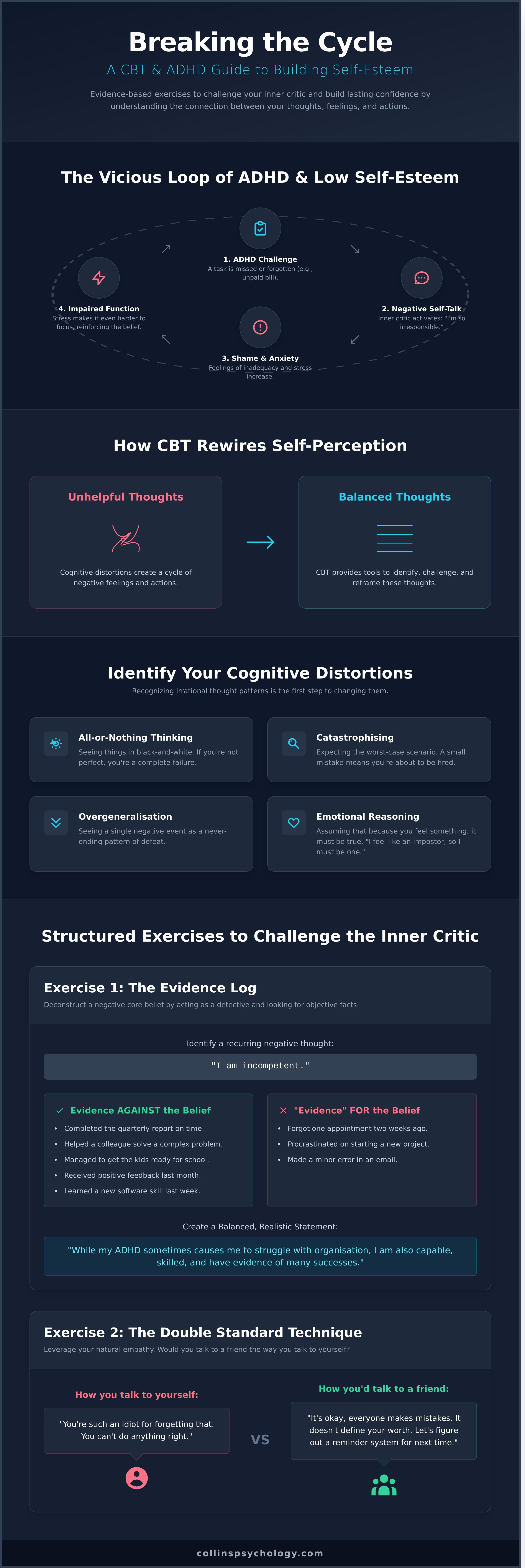
A challenging cycle often develops where the symptoms of ADHD create situations that reinforce negative self-talk, which in turn worsens the symptoms. Forgetting an important appointment or missing a deadline is not just a logistical problem; it becomes evidence for the inner critic that you are unreliable or incompetent. This can lead to "masking," the exhaustive effort of hiding symptoms to appear neurotypical, which erodes authentic self-worth over time. This experience is often compounded by comparing your internal struggles with the curated external successes of others, further deepening feelings of inadequacy (Fedele et al., 2012).
Grieving the Undiagnosed Years
For adults diagnosed later in life, there is often a significant emotional weight attached to the past. Looking back, they may re-evaluate years of difficulties through the new lens of ADHD. Past criticisms from teachers, parents, or employers that were once internalised as character flaws ("you're lazy," "you're not living up to your potential") are now understood as symptoms of an unmanaged condition. It is important to acknowledge and validate the frustration and sadness that can accompany this realisation.
How Cognitive Behavioural Therapy Rewires Self-Perception
Rather than simply focusing on "thinking positively," Cognitive Behavioural Therapy (CBT) offers a structured, evidence-based framework for changing the underlying thought patterns that damage self-esteem. It is a practical approach that is particularly effective for the ADHD brain.
A Structured, Evidence-Based Approach
CBT is a well-researched psychological intervention that helps individuals identify and change unhelpful thinking patterns and behaviours (Beck, 2021). Its effectiveness for managing the emotional and functional challenges of adult ADHD is well-documented (Knouse & Mitchell, 2015).
Targeting Thoughts, Feelings, and Behaviours
CBT operates on the principle that our thoughts, feelings, and actions are interconnected. By learning to challenge negative thoughts, we can change our emotional responses and subsequent behaviours, breaking the cycle of low self-esteem.
Following Professional Guidelines
The strategies discussed here are aligned with professional practice guidelines, such as those upheld by the Psychological Society of Ireland (PSI), ensuring a responsible and effective approach.
Why Structure is Essential for the ADHD Brain
The ADHD brain thrives on structure and clarity. The methodical, step-by-step nature of CBT provides a clear pathway, reducing the overwhelm that can come with vague "self-help" advice.
Identifying Cognitive Distortions in ADHD
The first step in CBT is to become an observer of your own thoughts and to recognise recurring patterns of negative thinking known as cognitive distortions.
All-or-Nothing Thinking
Seeing things in black-and-white terms. For example, if you do not complete your entire to-do list, you consider the whole day a failure.
Catastrophising
Automatically assuming the worst-case scenario. For instance, a small mistake at work leads to the belief that you will be fired.
Overgeneralisation
Taking one negative event as evidence of a never-ending pattern. For example, "I forgot to pay that bill, so I am always irresponsible with money."
Emotional Reasoning
Believing that what you feel must be true. For example, "I feel like a fraud, so I must be one."
By learning to spot these distortions as they happen, you create the mental space needed to challenge them. A key clinical tool for this is a "thought record," where you log a situation, the automatic thought it triggered, and the resulting emotion.
The Evidence-Based Approach to Self-Worth
Stable self-esteem is built on a foundation of emotional regulation and balanced thinking. CBT provides the tools to develop these skills. By systematically evaluating your thoughts, you learn that they are not facts and can be changed. This process, supported by structured programs like CBT for emotional regulation, empowers you to build a more resilient and compassionate self-view.
Challenging the Internal Critic with Structured Exercises
Once you can identify negative thought patterns, the next step is to actively challenge them. These CBT exercises are designed to interrupt the cycle of negative self-evaluation and build a more realistic and compassionate inner voice.
Interrupting the Cycle
The goal is not to eliminate negative thoughts but to change your relationship with them. These exercises provide a structured way to respond to your inner critic instead of automatically accepting its claims.
The "Evidence For and Against" Exercise
This technique involves treating a negative thought like a hypothesis in a scientific experiment and looking for objective evidence.
The "Double Standard" Technique
This exercise leverages our natural ability to be compassionate to others by asking a simple question: "Would I say this to a friend in the same situation?"
Practising During a Busy Day
These exercises can be adapted for busy schedules. You can do a quick mental check-in or use a notes app on your phone to jot down a thought to analyse later.
The Evidence for and Against Exercise
This is a core CBT technique for creating a more balanced perspective.
Identify the Negative Belief
Write down a recurring negative thought, such as "I am lazy and unproductive."
Gather Evidence Against the Belief
Actively search for objective facts that contradict this thought. For example: "I finished that report last week," "I made dinner for my family three times this week," or "I helped my child with their homework." Be specific.
Gather Evidence For the Belief
Acknowledge the "evidence" your brain uses to support the thought. For example: "I did not go to the gym today," or "I procrastinated on making a phone call."
Write a Balanced, Realistic Statement
Based on all the evidence, create a new, more accurate thought. For example: "While I sometimes struggle with procrastination because of my ADHD, I am also capable and get many important things done."
Building Self-Compassion Through Awareness
Self-compassion is not about letting yourself off the hook; it is about treating yourself with the same kindness you would offer a friend. It involves acknowledging that ADHD is a real, biological condition, not a character flaw (Neff, 2003).
A simple but powerful exercise is the "Self-Compassion Break." When you notice you are being hard on yourself, pause and do the following:
Acknowledge the Pain
Say to yourself, "This is a moment of struggle."
Connect with Common Humanity
Remind yourself, "Struggle is a part of life. Other people feel this way too."
Offer Yourself Kindness
Place a hand over your heart and say, "May I be kind to myself."
This practice helps to regulate your emotional response in the moment and builds a habit of self-support. This foundation of self-compassion makes it easier to engage in constructive behaviours like goal setting to create opportunities for small, confidence-building wins.
Practical Executive Functioning Exercises to Boost Confidence
Self-esteem is not built in a vacuum. It is often a direct result of feeling competent and effective in your daily life. By improving your executive functioning skills, you create tangible proof of your capabilities, which directly counters the negative self-talk associated with ADHD.
Competence Builds Confidence
Each time you successfully complete a task you set out to do, you send a powerful message to your brain that you are capable. This is why focusing on executive function management is a cornerstone of building self-worth.
The "Task Breakdown" Exercise
This technique is designed to combat the feeling of overwhelm that often leads to procrastination and reinforces a sense of failure.
"Time Auditing" for Realistic Expectations
This exercise helps address "time blindness," a common ADHD trait where estimating the time needed for tasks is difficult. This can lead to over-committing and feeling like a failure when you cannot meet your own unrealistic expectations.
The Micro-Task Breakdown Technique
Large, vague tasks are the enemy of the ADHD brain. This technique makes them manageable.
Choose One Goal
Select a single task you have been avoiding, for example, "tidy the kitchen."
Divide it into Five-Minute Actions
Break the task down into the smallest possible steps. "Tidy the kitchen" becomes: "Collect all the mugs," "Put dirty dishes in the dishwasher," "Wipe the counter," "Sweep the floor."
Focus on One Action
Commit to doing just one of those five-minute actions. The small dopamine release from checking off even a tiny item can provide the momentum to continue.
Set Realistic Daily Goals
Aim to complete just a few micro-tasks each day rather than creating an impossibly long list. This strategy helps you avoid the "failure trap" and consistently build a sense of accomplishment.
Time Auditing for Realistic Self-Expectations
This exercise helps to align your perception of time with reality.
Estimate vs. Actual
Before starting a common task (e.g., writing an email, getting ready to leave the house), write down how long you think it will take.
Time the Task
Use a timer to record how long it actually takes.
Compare and Adjust
Note the difference. Over time, you will develop a more accurate internal clock for your daily activities.
Build in Buffer Time
Once you have a more realistic sense of timing, start adding "buffer time" to your schedule. If a journey takes 30 minutes, plan for 45. This reduces the stress of being late and the associated feelings of shame.
Accessing Flexible CBT Resources for ADHD Growth
Taking the step to work on your self-esteem is a significant commitment. Recognising the need for flexibility and self-pacing is key to long-term success.
At Collins Psychology, we provide online, self-paced CBT programs designed specifically for adults with ADHD. It is important to clarify that we do not offer one-to-one therapy. Our model is built to empower you with the tools and knowledge to make meaningful changes on your own schedule, providing a structured path forward without the constraints of traditional appointments.
The Benefits of Online Self-Paced Learning
This model offers several advantages for the ADHD brain.
Flexibility
Digital modules allow you to learn when your focus is at its peak, whether that is early in the morning or late at night.
Comprehensive Resources
Our programs include a variety of materials, such as videos, written guides, and practical exercises, catering to different learning styles.
Removes the "Where Do I Start?" Barrier
A structured program provides a clear, step-by-step curriculum, eliminating the overwhelm of trying to figure out what to do next.
Taking the Next Step Toward Higher Self-Esteem
Building self-esteem is a journey of small, consistent actions. The most powerful thing you can do is start today. Choose one small exercise from this article and commit to trying it.
If you are ready to follow a structured, evidence-based path to managing your ADHD and improving your self-worth, we invite you to explore our training.
Access our self-paced CBT programs for Adult ADHD
For more information about our programs, please contact us.
Frequently Asked Questions
How does ADHD affect self-esteem in adults?
ADHD affects self-esteem through the chronic challenges posed by executive dysfunction. Difficulties with organisation, time management, and follow-through can lead to a history of perceived failures at school, work, and in relationships, fostering a negative self-image and a harsh inner critic.
Can CBT exercises really help with low self-esteem?
Yes. CBT is an evidence-based approach that helps individuals identify, challenge, and reframe the negative thought patterns that fuel low self-esteem. By changing your thoughts and behaviours, you can build a more balanced and compassionate view of yourself (Knouse & Mitchell, 2015).
What are some quick self-esteem exercises for ADHD?
A quick exercise is the "Self-Compassion Break": pause, acknowledge you are struggling, remind yourself that everyone struggles, and offer yourself a kind thought. Another is the "One-Thing" rule: identify one small, manageable task and complete it to get an immediate sense of accomplishment.
Why do I feel like a failure even when I am successful?
This is often due to cognitive distortions like "disqualifying the positive," where you dismiss your achievements as luck or "not a big deal." It can also be linked to an internalised "failure identity" from past struggles, which persists even in the face of new evidence.
How can I stop the negative self-talk associated with ADHD?
You can start by treating the negative self-talk as a habit to be changed, not a fact. Use CBT exercises like "Evidence For and Against" to challenge the validity of the negative thoughts. Consistently replacing the critical voice with a more balanced and realistic one will weaken the old habit over time.
Is it too late to improve my self-esteem if I was diagnosed as an adult?
It is never too late. The brain has a remarkable ability to change and learn new patterns (neuroplasticity). A late diagnosis can be the catalyst for profound self-understanding and growth, providing the context needed to finally address long-standing issues with self-esteem.
How do executive functioning exercises help with confidence?
Confidence is built on evidence of competence. When you use exercises like task breakdown to successfully complete tasks you previously avoided, you create tangible proof of your capability. Each small success serves as a building block for greater self-trust and confidence.
What is the best way to start a CBT program for ADHD?
The best way to start is with a structured, self-paced program that allows you to learn and apply concepts consistently without feeling overwhelmed. An online program designed for adults with ADHD can provide the right balance of information, practical exercises, and flexibility.
References
Barkley, R. A. (2015). Attention-deficit hyperactivity disorder: A handbook for diagnosis and treatment (4th ed.). The Guilford Press.
Beck, J. S. (2021). Cognitive behavior therapy: Basics and beyond (3rd ed.). The Guilford Press.
Fedele, D. A., Lefler, E. K., & Hartung, C. M. (2012). The relationship between internalising symptoms and the academic and social functioning of adolescents with ADHD. Journal of Attention Disorders, 16(7), 541–551.
Knouse, L. E., & Mitchell, J. T. (2015). A review of the effects of cognitive-behavioral therapy for adult attention-deficit/hyperactivity disorder. Journal of Consulting and Clinical Psychology, 83(3), 563–578.
Neff, K. D. (2003). Self-compassion: An alternative conceptualization of a healthy attitude toward oneself. Self and Identity, 2(2), 85–101.
Young, S., Adamo, N., Ásgeirsdóttir, B. B., et al. (2020). Females with ADHD: An expert consensus statement from the European ADHD Guidelines Group. BMC Psychiatry, 20(1), 404.