.png)

For many adults with ADHD, the space between knowing what needs to be done and actually doing it can feel like an unbridgeable chasm. This is not a failure of character, willpower, or intelligence, but a neurological reality rooted in the brain's unique wiring. The chronic frustration of seeing your potential while feeling stuck in inaction is a common and exhausting experience. This article will explore the biological reasons behind ADHD motivation issues and introduce evidence-based Cognitive Behavioural Therapy (CBT) strategies. By understanding the 'why' and learning the 'how', you can begin to build the external scaffolding needed to move from intention to action, replacing self-criticism with effective, structured techniques.
The Dopamine Deficit: Understanding the Biological Basis of ADHD Motivation Issues
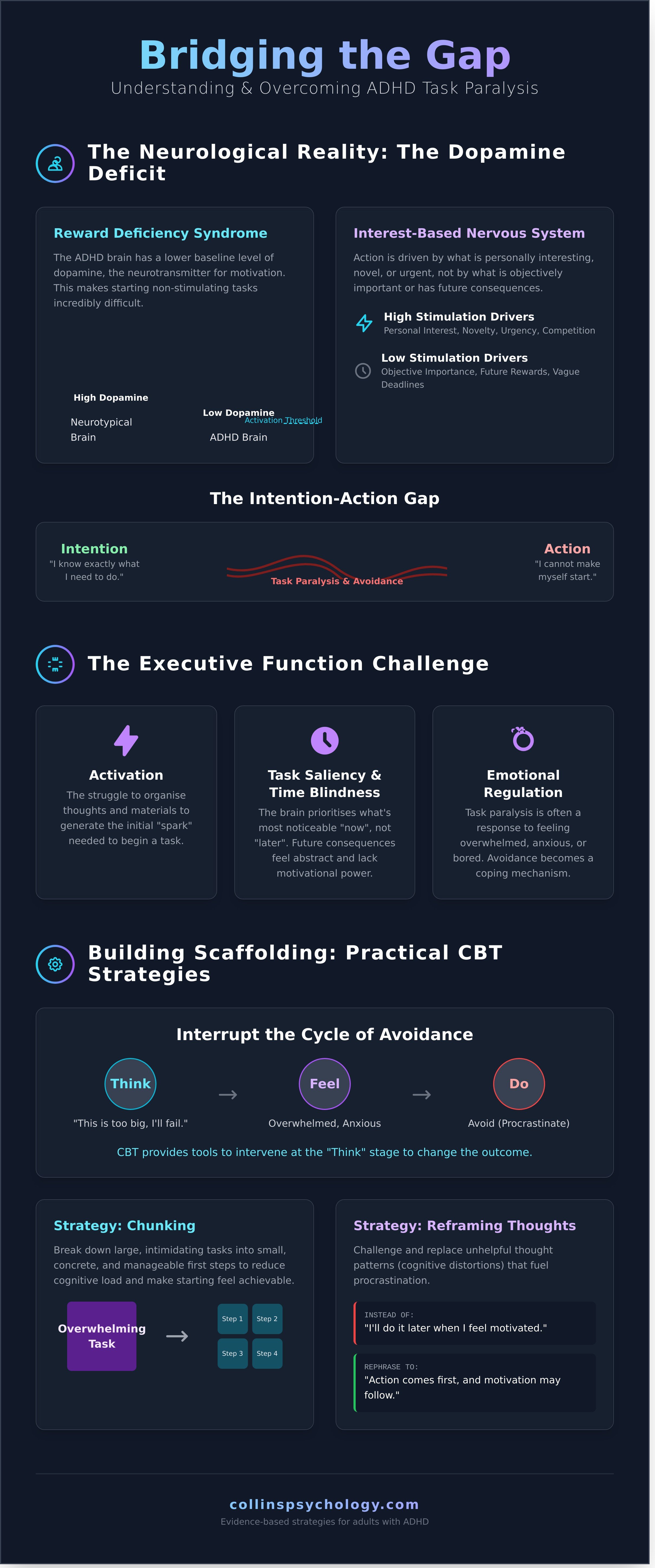
The core of the motivation challenge in Attention-Deficit Hyperactivity Disorder (ADHD) lies in the brain's reward system. This system, heavily reliant on the neurotransmitter dopamine, is responsible for signalling which activities are worth our energy. In the neurotypical brain, this system functions smoothly, but for adults with ADHD, it operates differently. This is often described in clinical literature as a form of Reward Deficiency Syndrome, where the brain's baseline level of dopamine is lower, and its response to dopamine signals is less pronounced (Volkow et al., 2009). Consequently, tasks that are not inherently interesting or immediately rewarding fail to generate enough neurochemical stimulation to get started. The ADHD brain requires a much higher level of engagement or urgency to activate. This is why you might be able to hyperfocus for hours on a new hobby but struggle to begin a simple, mundane work email. This experience is often framed as having an "Interest-Based Nervous System" rather than an "Importance-Based Nervous System," meaning that personal interest, novelty, or urgency are the primary drivers of action, not a task's objective importance or future consequences.
The Role of Dopamine in Task Initiation
Dopamine is more than just a "pleasure chemical"; it is the chemical of motivation and action. It acts as the neurological bridge between wanting to do something and marshalling the physical and mental resources to do it. For any task to begin, the brain needs to reach a certain biological "floor" of stimulation. If a task is perceived as boring or having a distant, non-tangible reward, the ADHD brain may not produce enough dopamine to cross that activation threshold (Volkow et al., 2009). This is the biological reality behind the feeling of being "stuck" or paralysed, even when you consciously understand the importance of the task at hand.
Why Willpower is an Unreliable Tool for ADHD
Many adults with ADHD are told they just need to "try harder" or apply more willpower. However, this advice misunderstands the neurological nature of the condition. Willpower is a finite cognitive resource that is quickly depleted when fighting against the brain's fundamental wiring. Forcing yourself to do a low-stimulation task is like trying to push a car with an empty fuel tank; it is exhausting and ultimately ineffective. This creates the "Intention-Action Gap," a term describing the painful space where high-functioning, intelligent adults know exactly what they should be doing but cannot make themselves start. This is not a moral failing; it is an executive function challenge that requires strategy, not shame. Validating this experience is the first step toward letting go of internalised guilt and embracing more effective approaches.
Executive Functioning and the Intention-Action Gap
Motivation is not a single skill but the output of several complex cognitive processes known as executive functions. These are the management systems of the brain, governing our ability to plan, organise, initiate, and regulate ourselves to achieve goals. In ADHD, deficits in these functions create significant barriers to follow-through. A key challenge is "Activation," which is the ability to organise thoughts and materials to begin a task. Even simple sequences can feel overwhelming when the brain struggles to generate the initial spark. Furthermore, difficulties with emotional regulation can have a profound impact on the ability to sustain effort, as feelings of frustration, boredom, or anxiety can quickly derail a task. For a structured approach to improving these skills, our CBT for ADHD Executive Function course provides in-depth learning.
The Challenge of Task Saliency
One of the most significant executive challenges for adults with ADHD is prioritising tasks based on long-term consequences. The brain is wired to respond to what is most salient, or noticeable, in the present moment. Future rewards or punishments feel abstract and lack motivational power. This is compounded by "Time Blindness," a common ADHD trait where time is perceived not as a linear progression but as "now" and "not now." Without the imminent pressure of a deadline, there is no sense of urgency to drive action. This is why a professional project due in two months may feel impossible to start, while a fascinating but unimportant internet search can command hours of focused attention.
Emotional Regulation as a Motivational Barrier
Often, what looks like a motivation problem is actually an emotional regulation problem. The inability to start a task, known as "Task Paralysis," is frequently a response to feeling overwhelmed, anxious, or fearful. The brain's threat-detection system can interpret a challenging or boring task as something to be avoided, triggering a freeze response. Perfectionism is a common culprit; the fear of not doing a task perfectly can be so intimidating that it becomes easier not to start at all. This cycle of anxiety and avoidance is a powerful motivational barrier. The CBT for ADHD Emotional Regulation module offers targeted strategies for managing these emotional responses.
Cognitive Behavioural Strategies for Overcoming Task Paralysis
Cognitive Behavioural Therapy (CBT) is widely recognised as a gold-standard, non-pharmacological approach for managing the challenges of adult ADHD (Safren et al., 2005). Rather than focusing on "trying harder," CBT provides a framework of practical skills to change patterns of thinking and behaviour. It operates on the "Think-Feel-Do" cycle, recognising that our thoughts about a task directly influence our feelings, which in turn dictate our actions. For ADHD procrastination, a negative thought like "This is too big, I will fail" leads to feeling overwhelmed, which results in avoidance. CBT helps to intervene at the "think" stage to enable a different outcome. A core strategy is "Chunking," which involves breaking down large, intimidating tasks into small, concrete, and manageable steps. This reduces the cognitive load and makes the initial step feel achievable. These strategies are most effective when learned and applied consistently, which is the focus of structured CBT programmes.
Reframing Cognitive Distortions
Adults with ADHD often develop unhelpful thought patterns, or cognitive distortions, as a result of years of struggling with motivation. A common one is, "I will do it later when I feel like it," which assumes motivation must precede action. A CBT-based reframe is, "Action comes first, and motivation may follow." Another is "All or Nothing" thinking, where if you cannot do a task perfectly or completely, you do not do it at all. The CBT approach is to reframe this to "Done is better than perfect" or "I will just do one small part." Research consistently shows that applying these cognitive reframing techniques can significantly improve motivational outcomes for adults with ADHD (Safren et al., 2005).
The 5-Minute Rule and Task Initiation
One of the most powerful CBT techniques for bypassing the activation barrier is the "5-Minute Rule." The psychological mechanism is simple: the biggest hurdle is starting. By committing to work on a task for just five minutes, you lower the perceived effort and emotional resistance. This low-friction entry point is often enough to overcome the initial inertia.
Here is a step-by-step guide:
• Choose a task you have been avoiding.
• Set a timer for five minutes.
• Work on the task with the full permission to stop when the timer goes off.
• When the timer sounds, you have a choice: stop, or continue if you have built some momentum.
More often than not, starting is enough to generate the dopamine needed to keep going. This technique breaks the cycle of procrastination by focusing on initiation, not completion.
Building Structural Scaffolding: Time Management and Environmental Cues
Because ADHD involves challenges with internal executive functions, the most effective strategies involve creating external support systems. This concept is known as "Scaffolding." Instead of relying on memory, willpower, or internal motivation, you build a reliable external structure of tools, routines, and environmental cues to guide your actions (Barkley, 2015). This means making time visible with analogue clocks, calendars, or timers to combat Time Blindness. It also involves designing your environment to promote focus. For example, if you want to start a task, you should remove all visible distractions and place only the necessary tools in your line of sight. For practical guidance on implementing these structures, see our Goal Setting for ADHD programme.
Externalising the Reward System
The ADHD brain responds best to rewards that are immediate, frequent, and tangible. Since it does not generate enough internal motivation for long-term goals, you must build an external reward system. This can involve creating "Artificial Deadlines" by asking a colleague or friend to check in with you on a specific date, creating external accountability. It also means pairing an unpleasant task with an immediate reward. For example, you might allow yourself 15 minutes of a favourite activity only after you have completed a 25-minute work block. The key is to make the reward contingent on completing the task and to deliver it as soon as possible.
Managing the Physical Environment
Your physical environment sends constant signals to your brain about what to do next. The "Point of Performance" concept is crucial here: place the tools you need for a task exactly where you will perform it. If you want to go for a run in the morning, put your running shoes and clothes right next to your bed. Conversely, increase the friction for distracting activities. Visual clutter can also be highly distracting, as each item competes for your attention and drains cognitive resources. Creating an organised, ADHD-friendly workspace with designated zones for different activities can significantly reduce the mental effort required to stay on task and feel motivated.
Navigating Change with Self-Paced CBT Programmes
Understanding the principles of managing ADHD is the first step, but consistent implementation is what creates lasting change. At Collins Psychology, we provide online, self-paced CBT programmes designed specifically for adults with ADHD. Recognising that the structure of traditional therapy can be a barrier for some, our model is built for flexibility. A self-paced programme allows you to engage with the material when your brain is most receptive, without the pressure of fixed appointments. It is important to clarify that Collins Psychology does not offer one-to-one therapy sessions. Instead, we provide a comprehensive curriculum of resources, exercises, and tools that empower you to learn and apply these crucial skills independently.
The Benefits of Online Learning for ADHD
An online, self-paced learning model offers several distinct advantages for the ADHD brain. Firstly, it gives you the ability to pause, rewind, and revisit complex clinical concepts as many times as you need to, ensuring genuine understanding. Secondly, the modular format allows you to "Hyperfocus" on the specific areas you need most, whether it is emotional regulation, time management, or task initiation. Finally, this approach can reduce the "Appointment Anxiety" and executive function demands (like scheduling and travel) associated with traditional therapy, making it a more accessible and sustainable path to improvement.
Taking the Next Step in Your ADHD Journey
Moving from understanding your ADHD to actively managing it is a transformative process. It requires a commitment to learning and consistently applying new strategies. The Collins Psychology online curriculum is designed to guide you on this journey, providing the structured, evidence-based framework needed to build new habits and systems. The programmes are designed to help you bridge the intention-action gap and build a life that aligns with your goals and values.
Ready to start building your skills? Enrol in our online, self-paced CBT for Adult ADHD programme today.
Frequently Asked Questions
Why do I have no motivation with ADHD even when I care about the task?
This happens because the ADHD brain's reward system is primarily driven by interest, novelty, or urgency, not by importance. A task you care about may not provide enough immediate neurochemical stimulation (dopamine) to overcome the brain's "activation" threshold.
Is ADHD lack of motivation actually laziness?
No. Laziness is a choice not to do something despite being able to. Lack of motivation in ADHD is a neurological challenge related to deficits in executive functions and the brain's dopamine pathways. It is an inability to start or sustain effort, not an unwillingness to do so.
Can Cognitive Behavioural Therapy (CBT) help with ADHD motivation issues?
Yes, CBT is a highly effective, evidence-based approach. It provides practical strategies to reframe unhelpful thoughts, break down tasks into manageable steps, manage emotional overwhelm, and build external systems (scaffolding) to support task initiation and completion.
How does dopamine affect motivation in adults with ADHD?
Dopamine is a key neurotransmitter for motivation and action. In ADHD, the dopamine system is less efficient, meaning the brain requires higher levels of stimulation to feel motivated. This makes it difficult to engage with tasks that are perceived as boring or have delayed rewards.
What is task paralysis and how can I break out of it?
Task paralysis is the overwhelming feeling of being "stuck" and unable to start a task, often due to anxiety, perfectionism, or feeling overwhelmed. A powerful technique to break out of it is the "5-Minute Rule": commit to working on the task for just five minutes. This lowers the barrier to entry and can help build momentum.
Does the lack of motivation in ADHD ever go away?
ADHD is a lifelong condition, so its underlying neurology does not go away. However, through effective strategies like CBT, environmental structuring, and building self-awareness, you can learn to manage and work with your brain's unique wiring, significantly improving your ability to initiate and complete tasks.
How can I stay motivated to exercise with ADHD?
Find a form of exercise that is genuinely interesting or novel. Use external accountability by working out with a friend. Lower the friction by having your workout clothes ready. Finally, pair it with an immediate reward, such as listening to a favourite podcast only while you exercise.
Why do I only feel motivated when there is a deadline?
Deadlines create a sense of urgency, which provides the high level of stimulation the ADHD brain needs to activate. The imminent consequence of not finishing the task floods the brain with the neurochemicals (like adrenaline and dopamine) needed to focus and take action.
References
Barkley, R. A. (2015). Attention-deficit hyperactivity disorder: A handbook for diagnosis and treatment (4th ed.). The Guilford Press.
Safren, S. A., Otto, M. W., Sprich, S., Winett, C. L., Wilens, T. E., & Biederman, J. (2005). Cognitive-behavioral therapy for ADHD in medication-treated adults with continued symptoms. Behaviour Research and Therapy, 43(7), 831–842.
Volkow, N. D., Wang, G. J., Kollins, S. H., Wigal, T. L., Newcorn, J. H., Telang, F., Fowler, J. S., Zhu, W., Logan, J., Ma, Y., Pradhan, K., Felix, C., & Swanson, J. M. (2009). Evaluating dopamine reward pathway in ADHD: clinical implications. JAMA, 302(10), 1084–1091.