.png)

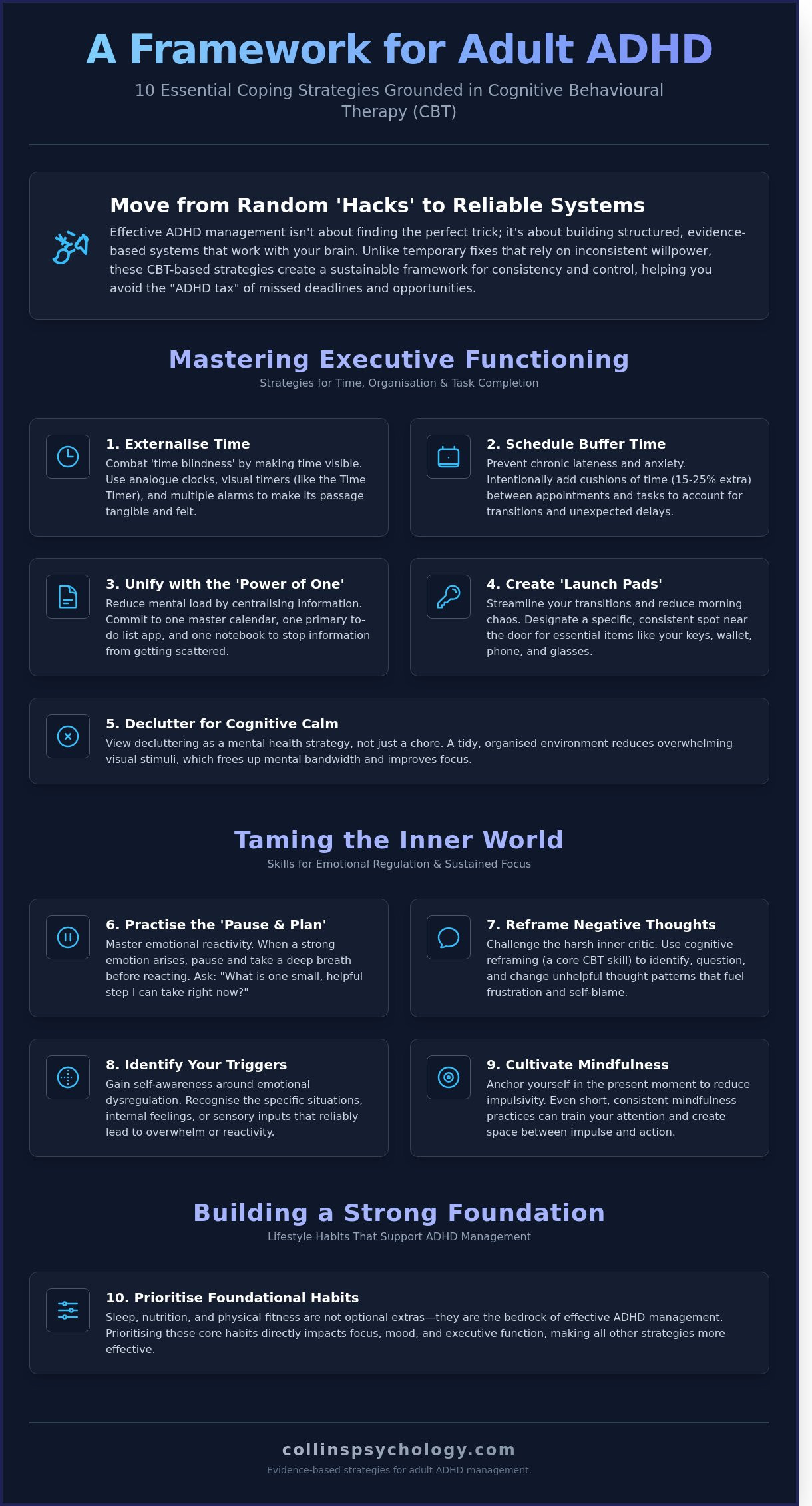
Managing the daily demands of life with adult ADHD can feel like a constant battle against procrastination, overwhelm, and emotional reactivity. If you have tried countless productivity hacks and tips only to find they do not stick, you are not alone. This guide moves beyond temporary fixes to introduce ten essential, evidence-based adult ADHD coping strategies grounded in a Cognitive Behavioural Therapy (CBT) framework. You will learn how to build sustainable systems that work with your unique brain wiring, empowering you to not only know what to do but to actually do it consistently.
Key Takeaways
•
Effective ADHD management relies on structured, evidence-based systems, not random "hacks" that often increase frustration.
•
Cognitive Behavioural Therapy (CBT) provides a robust framework for targeting the core challenges of adult ADHD, including executive dysfunction and emotional dysregulation.
•
Strategies should focus on externalising executive functions like time management and organisation through visual cues, dedicated tools, and consistent routines.
•
Emotional regulation is a key skill that can be developed through techniques like cognitive reframing, mindfulness, and identifying personal triggers.
•
Sustainable change comes from building a personalised toolkit of strategies across life domains, which is best achieved through a structured, self-paced programme.
Table of Contents
•
Understanding Adult ADHD and the Need for Structured Coping
•
Mastering Executive Functioning: Time Management and Organisation
•
Strategies for Emotional Regulation and Sustaining Focus
•
Foundational Lifestyle Habits: Sleep, Fitness, and Parenting
•
Transitioning from Random Tips to a Structured CBT Programme
•
Understanding Adult ADHD and the Need for Structured Coping
Adult ADHD coping strategies are behavioural and cognitive adjustments designed to manage the core symptoms of inattention, hyperactivity, and impulsivity. Unlike generic productivity tips, these methods are tailored to address the underlying executive function and emotional regulation challenges inherent to the ADHD brain. Many adults find that popular "hacks" fail because they rely on willpower or motivation, resources that can be inconsistent and unreliable for someone with ADHD. The key is to stop relying on motivation and instead build systems that work with your brain, which is where a structured framework like Cognitive Behavioural Therapy (CBT) becomes essential. CBT is widely recognised as an effective, evidence-based approach for building practical, long-term skills for managing adult ADHD (Ramsay & Rostain, 2015).
The Limitations of Unstructured Advice
Jumping from one popular tip to another, a behaviour often called "strategy hopping," can lead to a cycle of initial hope followed by frustration and self-blame. This happens because random advice rarely addresses the root cause of ADHD-related challenges. The ADHD brain struggles with executive functions like planning, organising, and initiating tasks due to differences in neurological structure and function (Barkley, 2012). This is why external structure is not just helpful; it is often necessary. This constant struggle to keep up can lead to the "ADHD tax," a term for the real-world costs of symptoms, such as late fees, missed opportunities, or the mental health toll of feeling perpetually behind.
According to comprehensive ADHD management strategies, this is a well-documented area of ongoing research and practical application.
Why Evidence-Based Frameworks Matter
Relying on clinically supported methods provides a reliable path forward, removing the guesswork and frustration from managing your symptoms. An evidence-based framework like CBT offers a cohesive system where each strategy builds upon the last, creating a comprehensive toolkit for daily life. These strategies are most effective when learned and applied consistently, which is why a structured programme can provide the scaffolding needed to turn knowledge into action. By committing to an evidence-based approach, you move from endlessly seeking new information to building a reliable support system that helps you know what to do and actually do it.
Mastering Executive Functioning: Time Management and Organisation
Challenges with executive functioning are a hallmark of adult ADHD, directly impacting your ability to manage time, organise belongings, and complete tasks. Instead of trying to force your brain to work differently, effective strategies focus on externalising these functions. This means using external tools and systems to do the heavy lifting that your brain finds difficult. For example, you can combat "time blindness," the common difficulty in sensing the passage of time, by making time physical and visible through timers, alarms, and visual calendars.
Practical Tools for Time Management
Using timers is a cornerstone of ADHD time management, but their use extends beyond simple deadlines. Set timers to signal transitions between tasks, helping to break the grip of hyperfocus or overcome the inertia of procrastination. Another crucial technique is scheduling "buffer time" between appointments and tasks, which realistically accounts for the unexpected delays and transitions that often derail an ADHD-friendly schedule. These small adjustments create a more forgiving and functional daily structure, reducing chronic lateness and the anxiety it causes. For more in-depth techniques, explore our guide to managing disorganisation and poor time management with CBT.
Research published by NIMH guide to ADHD shows that this is a well-documented area of ongoing research and practical application.
Organisational Systems That Stick
To create organisational systems that last, they must be simple and visible. The "Power of One" strategy involves committing to one calendar for all appointments, one notebook for all notes, and one master to-do list, which reduces the mental load of tracking information across multiple platforms. Creating "launch pads" near the door for essential items like keys, wallet, and phone dramatically reduces morning chaos. Similarly, approaching decluttering as a cognitive strategy to reduce overwhelming visual stimuli, rather than just a chore, can make the process more meaningful and sustainable.
Strategies for Emotional Regulation and Sustaining Focus
Emotional dysregulation is now understood as a central component of the adult ADHD experience, manifesting as intense frustration, irritability, or sensitivity to criticism (Shaw et al., 2014). These strong emotional responses can be just as disruptive as inattention or hyperactivity. A key CBT-based strategy is the "Pause and Plan" technique, where you consciously create a space between an emotional trigger and your reaction. This pause allows you to engage your thinking brain and choose a more measured response rather than acting on impulse.
Building Emotional Resilience
Building emotional resilience involves learning to identify and manage your emotional triggers before they escalate. One effective method is to practise grounding techniques, such as focusing on the sensation of your feet on the floor or naming five things you can see, to anchor yourself during moments of intense emotion. Another powerful strategy is cognitive reframing, particularly for managing Rejection Sensitive Dysphoria (RSD), which involves challenging the catastrophic thoughts that often follow perceived criticism or rejection. Learning to question these automatic negative thoughts can significantly lessen their emotional impact. For a deeper dive, read about understanding Rejection Sensitive Dysphoria in adults with ADHD.
Research published by HelpGuide's guide to managing adult ADHD shows that this is a well-documented area of ongoing research and practical application.
Enhancing Focus and Concentration
Sustaining focus with ADHD requires proactive environmental design. You can create a "low-friction" workspace by removing potential distractions from your line of sight and ensuring all necessary tools are easily accessible. Many people with ADHD also find that using "fidgets" or other sensory tools can help sustain mental engagement during tasks that are not inherently stimulating. It is important to distinguish this kind of productive focus from hyperfocus; productive focus is directed and intentional, while hyperfocus is an immersive state that can make it difficult to transition to other important tasks.
Foundational Lifestyle Habits: Sleep, Fitness, and Parenting
Core lifestyle habits form the foundation upon which all other coping strategies are built. The relationship between sleep quality and ADHD symptoms is bidirectional; poor sleep worsens symptoms, and ADHD symptoms often disrupt sleep (Wynchank et al., 2017). Similarly, regular physical exercise acts as a natural way to boost dopamine and norepinephrine, the key neurotransmitters implicated in ADHD, thereby improving focus and mood. Addressing these foundational areas is not just about general health; it is a direct and effective way to manage your ADHD.
Sleep Hygiene for the Racing Mind
A common challenge for adults with ADHD is a racing mind that refuses to switch off at night. The "Brain Dump" technique, where you write down all your worries, ideas, and to-do items for 10-15 minutes before bed, can help externalise these thoughts and clear your mind for rest. Establishing a consistent, low-stimulation evening routine is also critical. This means dimming the lights, avoiding screens, and engaging in a calming activity like reading to signal to your brain that it is time to wind down. If you struggle with rest, consider these structured CBT approaches for sleep issues in adults with ADHD.
ADHD Parenting and Fitness
Parenting with ADHD presents a unique set of challenges, especially when a child also has ADHD, as it can feel like managing chaos multiplied. The most important strategy is self-compassion and the use of systems that simplify household management, such as shared digital calendars and designated chore charts. For fitness, the key is to find activities you genuinely enjoy and integrate them into your routine in a low-friction way. This could mean short, 15-minute workouts at home or finding an accountability partner to make exercise a non-negotiable part of your week.
Transitioning from Random Tips to a Structured CBT Programme
Collins Psychology provides structured, CBT-based systems for adults with ADHD who are tired of knowing what to do but still struggling to do it. While articles like this provide valuable information, lasting change comes from applying these strategies systematically. A structured programme guides you through this process, helping you build your ADHD support system over time. It is not therapy and it is not coaching; it is a system designed to help you stop starting over every Monday and finally build momentum.
The Self-Paced Advantage
For many busy adults with fluctuating focus, a self-paced online programme is the most practical and accessible way to learn. You can engage with the material when your brain is most receptive and work through the exercises at a pace that suits your life. Our programmes provide practical tools, worksheets, and exercises that facilitate real-world application, helping you build systems that work with your brain. You can start where you struggle most, whether it is emotional regulation, executive functioning, or time management. It is one system with multiple entry points.
Next Steps for Your ADHD Journey
If you are ready to move from tip-seeking to skill-building, exploring a structured programme is the logical next step. It provides the framework and accountability needed to implement these strategies consistently and effectively. By investing in a system, you are giving yourself the tools to manage your daily life with greater confidence and less overwhelm. We invite you to learn more about how our structured, self-paced programmes can help you build a more functional and fulfilling life with ADHD.
Access our structured, self-paced CBT programmes for Adult ADHD to start building your system today.
Frequently Asked Questions
**What are the most effective adult ADHD coping strategies?
** The most effective strategies are those grounded in an evidence-based framework like CBT. They focus on externalising executive functions (e.g., using visual timers, calendars, and lists), developing emotional regulation skills (e.g., cognitive reframing), and building supportive lifestyle habits around sleep and exercise.
**How does Cognitive Behavioural Therapy (CBT) help with ADHD symptoms?
** CBT helps by providing practical, skills-based techniques to manage the real-world challenges of ADHD. It teaches you to identify and change unhelpful thought patterns and behaviours related to procrastination, disorganisation, and emotional reactivity, replacing them with more effective systems and responses.
**Can I manage adult ADHD without one-to-one therapy sessions?
** Yes, many adults can effectively manage their ADHD through structured, self-paced learning. Online programmes that teach CBT skills offer a flexible and accessible alternative to traditional therapy, allowing you to build a robust toolkit of strategies on your own schedule.
**What is the best way to improve time management with ADHD?
** The best way is to make time tangible and external. Use visual timers, set multiple alarms for transitions, plan your day in blocks, and always include buffer time between tasks. The goal is to rely on external cues rather than an internal sense of time.
**How do I stop feeling overwhelmed by my daily tasks?
** Break tasks down into incredibly small "micro-steps." Instead of "clean the kitchen," the first step might be "take the dishes to the sink." This bypasses the brain's overwhelm response and makes it easier to initiate tasks.
**What are some ADHD-friendly ways to regulate emotions?
** Practise the "Pause and Plan" technique to create space before reacting. Identify your personal triggers and have a pre-planned calming strategy, such as a short walk or listening to music. Cognitive reframing can also help challenge the intense negative emotions associated with Rejection Sensitive Dysphoria (RSD).
**Are there specific strategies for ADHD parenting challenges?
** Yes. Key strategies include creating predictable routines, using visual charts for chores and schedules, focusing on connection before correction, and practising self-compassion. Simplifying the environment and building systems for household management can reduce chaos for both parent and child.
**How can a structured online programme help me more than a blog post?
** A blog post provides information, but a structured programme provides a system for implementation. It guides you step-by-step, ensuring you build skills in a logical order and provides tools and exercises to help you apply what you have learned to your own life, leading to more sustainable change.
References
Barkley, R. A. (2012). Executive functions: What they are, how they work, and why they evolved. Guilford Press.
Ramsay, J. R., & Rostain, A. L. (2015). Cognitive-behavioral therapy for adult ADHD: An integrative psychosocial and medical approach (2nd ed.). Routledge.
Shaw, P., Stringaris, A., Nigg, J., & Leibenluft, E. (2014). Emotional dysregulation and attention-deficit/hyperactivity disorder. American Journal of Psychiatry, 171(3), 276–293. https://doi.org/10.1176/appi.ajp.2013.13070966
Wynchank, D., Bijlenga, D., & Beekman, A. T. (2017). Adult ADHD and sleep. In S. V. Faraone (Ed.), The World Federation of ADHD International Consensus Statement: 208 Evidence-based conclusions about the disorder (pp. 149-153). ADHD World Federation.
Disclaimer
Our programmes are designed to provide educational, evidence based CBT strategies to support adults with ADHD in everyday life. They are not a substitute for individual therapy or personalised care. If you are experiencing significant difficulties, we encourage you to seek support from a local qualified healthcare professional.